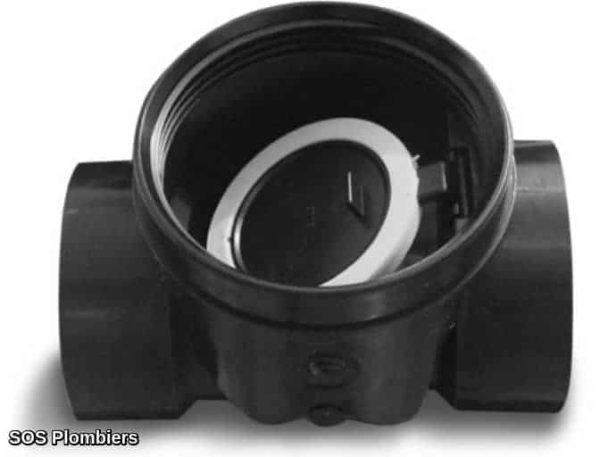
The right backwater valve protects the affected fixtures without compromising the drainage system
A backwater valve installation in Montréal cannot be determined from a photo or a single price. It is necessary to know which fixtures are below street level, where the branch lines run, how many units share the pipe, and what the municipality allows.
SOS Plombiers receives installation, replacement, and inspection requests 24 hours a day, 7 days a week. The address, building type, backup history, and known access points are collected in order to try to direct the request to a partner company available in the area.
The assigned partner checks the configuration on site and confirms the proposed device, access requirements, schedule, price, included work, invoice, and warranties.
New installationExposed fixtures, pipe routing, and local requirements.
ReplacementExisting access, diameter, material, and condition of the housing.
Under-slab workCutting, excavation, backfilling, concrete, and finishing to be specified.
THE NEED BEFORE THE MODEL
Three situations, three different types of work
The word “valve” may refer to a preventive project, a repair, or a sewer problem that must first be diagnosed.
PREVENTION
No backwater valve is visible
The low-level fixtures, the branch lines serving them, and possible access points must be located. The goal is not to install a device at random, but to protect the correct points without creating a prohibited restriction.
REPLACEMENT
A backwater valve is already installed
A fouled gate, worn seal, inaccessible cover, or incompatible model does not call for the same work. The condition of the pipe and housing matters just as much as the moving component.
AFTER A BACKUP
Wastewater has backed up
A backwater valve will not correct a blockage, sagging pipe, or improper connection. If the backup is active, stop using water and first consult the sewer backup service.
DO NOT CONFUSE THE EQUIPMENT
Sewer backwater valve, potable-water backflow prevention device, and sump pump
All of this equipment can prevent reverse flow, but it does not operate on the same system or protect against the same risk.
Sewer backwater valve
It operates on a drain line. It allows wastewater to leave the building, then must close when the system attempts to send it back toward the protected fixtures.
Backflow prevention device, or BPD
It protects the potable water system against contamination from a high-risk connection. It is not the sanitary backwater valve used for a toilet or basement drain.
Sump pump
It removes water collected in a pit. It addresses a separate infiltration or drainage problem; see the sump pump service.
WHAT IT CAN DO
Reduce the risk of reverse flow through protected fixtures
protect a toilet, shower, sink, washing machine, or floor drain connected to the targeted branch line;
close automatically when the direction of flow reverses;
limit damage when it is properly located, accessible, clean, and in working condition;
complement a set of resilience measures suited to the building.
WHAT IT CANNOT DO
Replace a building-specific diagnosis
repair a broken, sagging, blocked, or improperly sloped pipe;
prevent infiltration through the foundation, a low window, or a garage entrance;
remove water from a pit when the pump is missing or not working;
automatically protect every branch line in a multiplex or commercial building.
TYPE, LOCATION, AND VENTING
“A backwater valve on the main drain” is not a universal solution
The Construction Code regulates backwater valves, and municipalities may impose more restrictive rules. The number of dwelling units and the location within the system change which solution is permitted.
01 • NORMALLY CLOSED
On a branch line or group of fixtures
The gate remains closed at rest and opens for drainage. This targeted protection is common for fixtures located below street level, depending on the applicable configuration.
02 • NORMALLY OPEN
Possible under specific conditions
The RBQ provides that a model allowing air circulation may, under certain conditions, be installed on a main building drain serving only one dwelling unit. A municipality may nevertheless prohibit it in that location.
03 • SPECIFIC CONFIGURATION
Insert, housing, or existing device
The installation method, diameter, material, product certification, and maintenance access must be verified. The least invasive format is not necessarily the one suited to the system.
Decisive point: in Laval and Longueuil, the municipal regulations reviewed prohibit a backwater valve on the building’s main drain. A recommendation that is valid elsewhere should therefore not be copied without checking the address.
FROM LOCATING THE PIPE TO RETURNING IT TO SERVICE
How a durable installation is prepared
A serious estimate distinguishes the plumbing work, slab opening, and finishing. It also explains what happens if the exposed pipe does not match the initial information.
Assess the address
Municipality, number of dwelling units, building type, previous losses, and affected fixtures.
Trace the drainage system
Locate the branch lines, main drain, cleanouts, diameter, material, and probable depth.
Choose the protection
Determine which fixtures to protect and select a permitted, accessible, and compatible type.
Define the work
List the cutting, excavation, fittings, backfilling, concrete, finishing, and exclusions in the estimate.
Inspect and document
Check the direction, movement, seal, and access, and obtain an invoice identifying the installed model.
A camera inspection may be appropriate if the route is uncertain, the drain repeatedly becomes blocked, or a pipe defect is suspected. It is not automatically necessary for every project.
2026 BUDGET
How much does backwater valve installation cost?
There is no single official rate. Prices published in the Greater Montréal market vary mainly according to access, depth, material, number of devices, and the extent of the concrete work.
OVERALL PRICE RANGE$800 to $4,500+
From an accessible replacement to a complex under-slab project. This range is not a quote.
What to have included in writing in the estimate
backwater valve, fittings, and access cover;
locating, opening, and modifying the pipe;
cutting, excavation, and debris removal;
backfill, concrete, and the exact level of finishing;
permits, inspection, unforeseen conditions, and excluded work.
Indicative backwater valve price ranges in Greater Montréal in 2026
Scenario
Indicative range
Main variables
Accessible inspection or maintenance
$150 to $250
Access, condition of the cover, cleaning, and required parts.
Accessible replacement
$800 to $2,000
Compatibility, fittings, workspace, and condition of the housing.
Installation with straightforward access
$1,500 to $3,500
Locating, localized opening, installation, and creation of permanent access.
Under-slab installation
$2,500 to $4,500
Cutting, excavation, depth, material, and basic restoration.
Complex configuration
$4,500 and up
Cast iron, deep piping, several branch lines, prior corrections, or extensive restoration.
General market ranges verified in July 2026. They are neither a rate schedule nor a price guarantee. Taxes, travel charges, and inclusions must be confirmed. Each partner company sets its own pricing after reviewing the situation.
MONTREAL • RÉNOPLEX 2026
Check eligibility before authorizing the work
Ville de Montréal currently offers financial assistance for certain flood-protection work in buildings with 1 to 5 dwelling units. The amounts published on July 3, 2026, include:
$90per eligible normally closed backwater valve
$600per normally closed backwater valve installed beneath an existing slab
The backwater-valve amount alone does not determine eligibility
For Block 3, which covers flood protection, the program states that requirements include:
a building with 1 to 5 dwelling units located in Montreal;
a building value of no more than $3,860/m², based on the program’s calculation;
a minimum requested grant amount of $500 for this block;
compliance with the guide, technical requirements and requested documentation.
Do not begin the work based solely on this page. The City requires applicants to wait for confirmation of acceptance; otherwise, eligibility for the grant could be lost. It currently indicates a processing time of 3 to 4 months. Check the current conditions and amounts on the official website before signing.
Montreal, Laval and Longueuil do not treat every configuration the same way
The provincial Code provides the foundation, but municipal regulations and the building’s actual drainage system must be checked before selecting the location.
Montreal
The City illustrates protection installed on the piping serving each basement fixture or group of fixtures and requires easy access to be maintained. It ideally recommends inspection and maintenance twice a year.
By-law L-11870 requires protection on the applicable connections located below street-crown level, prohibits every type of backwater valve on the main building drain and requires the devices to remain accessible and maintained.
By-law CM-2005-382 applies to horizontal branches receiving wastewater from fixtures in a basement or cellar, prohibits backwater valves on main building drains and requires them to remain accessible and operational.
The West Island, North Shore and South Shore include several municipalities. Consult the municipality corresponding to the work address. Regulations and programs may change.
ACCESS IS PART OF THE INSTALLATION
A backwater valve hidden beneath a floor cannot be maintained properly
The access hatch or cover must remain identifiable and easy to open. Debris, grease or a deteriorated seal can prevent the flapper from closing at the critical moment.
locate the device and clear its cover;
check the gasket and condition of the components;
remove residue that interferes with movement;
confirm that the flapper moves freely and seats properly;
reassemble it according to the manufacturer’s instructions and record the date;
inspect it again after heavy rainfall or a suspected sewer backup.
Montreal ideally recommends maintenance twice a year; Laval recommends one or two inspections annually and after a relevant event. See also the backwater valve maintenance guide.
THE BUILDING CHANGES THE SCOPE
House, plex, condominium or commercial building
Single-family home
The pipe route may be simpler, but the low branches, main building drain, foundation drainage and municipal requirements must still be distinguished. A backwater valve on the main drain is not automatically permitted.
Plex and condominium
Several dwelling units may share a building drain. The fixtures, responsibilities, access to common areas and authorization from the condo corporation or owner must be clarified before the work begins.
Commercial and institutional
The number of fixtures, uses, shutdown periods, plans and potable-water protection devices may expand the scope. A technical visit must define the work precisely.
GREATER MONTREAL COVERAGE
A request assessed according to the address and availability
Coverage and response times are not identical everywhere. SOS Plombiers attempts to direct each request to a partner serving the relevant area.
These general answers do not replace an assessment of the pipe, building and requirements applying to the address.
What type of backwater valve should be installed?
The choice depends on the fixtures to be protected, the location within the drainage system, the number of dwelling units, diameter, material, venting and municipal regulations. A normally closed model on a branch and a normally open model on a building drain are subject to different conditions.
Can a backwater valve be installed on the main drain?
Not automatically. Under certain conditions, the RBQ permits a normally open backwater valve on a main building drain serving only one dwelling unit. Some municipalities nevertheless prohibit it. The Laval and Longueuil regulations reviewed prohibit backwater valves on the main building drain.
How much does backwater valve installation cost in 2026?
General ranges are approximately $800 to $2,000 for an accessible replacement, $1,500 to $3,500 for an installation with straightforward access and $2,500 to $4,500 for an under-slab installation. A complex configuration may exceed these amounts. Only an estimate following an assessment confirms the price.
Does the concrete slab need to be broken?
Not always. An accessible replacement may require limited work. If the targeted pipe is buried beneath the slab, a localized opening and excavation may be necessary. The estimate must specify the backfill, concrete and finishing that will be restored.
Is there a Montreal grant available in 2026?
The RénoPlex program currently lists $90 for an eligible normally closed backwater valve and $600 when it is installed beneath an existing slab. Other criteria apply, including the type and value of the building and a minimum requested grant amount. The City requires applicants to wait for acceptance before beginning the work.
Does the backwater valve prevent every basement flood?
No. It is intended to prevent certain types of backflow in the drainage system. It does not correct foundation infiltration, inadequate exterior drainage, a failed sump pump, an exposed garage entrance or an already blocked pipe.
What should you do if sewage is backing up now?
Stop using toilets, showers, sinks, the washing machine and dishwasher, keep people away from the contaminated area and request sewer-backup service. Preventive backwater valve installation should be planned after flow has been restored and the cause has been diagnosed.
How often should the backwater valve be maintained?
The frequency depends on the model, use and manufacturer’s instructions. Montreal ideally recommends two inspections per year; Laval recommends once or twice a year and after heavy rainfall or a suspected sewer backup. Access must remain clear.
Is a camera inspection necessary before installation?
Not for every project. It may be useful if the pipe route is uncertain, a blockage recurs, the condition of the pipe is questionable or a repair must be located. The partner must explain the objective of the inspection and its deliverables.
Who confirms the solution, price and warranty?
SOS Plombiers receives and assesses the request, then attempts to direct it to an available partner company. The assigned partner assesses the situation, proposes the solution, establishes its price and remains responsible for its work, invoice and warranties.
A PRECISE REQUEST PRODUCES A MORE USEFUL ESTIMATE
Describe the address, building and exposed fixtures
Provide the municipality, number of dwelling units, location of the basement fixtures, previous backups, any visible backwater valve and access to the pipe. SOS Plombiers will attempt to direct the request to a partner that can assess the configuration and confirm the work.
The assigned partner remains responsible for its diagnosis, estimate, work, invoice and warranties.
CUSTOMER EXPERIENCES
Reviews associated with services coordinated through the network
Reviews aggregated by Trustindex describe individual experiences. They do not guarantee the availability, price or outcome of a future service call.
Backwater Valve Montreal: Installation and Cost in 2026
Backwater valve installation or replacement in Montreal and Greater Montreal. 2026 pricing, RénoPlex, local requirements and requests accepted 24/7.
Home
Plumbing services in Greater Montreal
Installation de clapet anti-retour dans le Grand Montréal
SOS Plombiers
Plumbing services in Greater Montreal
Installation de clapet anti-retour dans le Grand Montréal
SOS Plombiers reçoit et qualifie les demandes d’installation, de remplacement et de vérification de clapets anti-retour d’égout dans le Grand Montréal, puis tente de les diriger vers une entreprise partenaire selon l’adresse, le type de bâtiment, la configuration décrite et la disponibilité. L’entreprise partenaire confirme sur place le diagnostic, le dispositif approprié, le prix, les travaux, la facture et ses garanties.
Montreal
Laval
Longueuil
West Island
Montreal North Shore
Montreal South Shore
Greater Montreal
What type of backwater valve should be installed?
The choice depends on the fixtures to be protected, the location within the drainage system, the number of dwelling units, diameter, material, venting and municipal regulations. A normally closed model on a branch and a normally open model on a building drain are subject to different conditions.
Can a backwater valve be installed on the main drain?
Not automatically. Under certain conditions, the RBQ permits a normally open backwater valve on a main building drain serving only one dwelling unit. Some municipalities nevertheless prohibit it. The Laval and Longueuil regulations reviewed prohibit backwater valves on the main building drain.
How much does backwater valve installation cost in 2026?
General ranges are approximately $800 to $2,000 for an accessible replacement, $1,500 to $3,500 for an installation with straightforward access and $2,500 to $4,500 for an under-slab installation. A complex configuration may exceed these amounts. Only an estimate following an assessment confirms the price.
Does the concrete slab need to be broken?
Not always. An accessible replacement may require limited work. If the targeted pipe is buried beneath the slab, a localized opening and excavation may be necessary. The estimate must specify the backfill, concrete and finishing that will be restored.
Is there a Montreal grant available in 2026?
The RénoPlex program currently lists $90 for an eligible normally closed backwater valve and $600 when it is installed beneath an existing slab. Other criteria apply, including the type and value of the building and a minimum requested grant amount. The City requires applicants to wait for acceptance before beginning the work.
Does the backwater valve prevent every basement flood?
No. It is intended to prevent certain types of backflow in the drainage system. It does not correct foundation infiltration, inadequate exterior drainage, a failed sump pump, an exposed garage entrance or an already blocked pipe.
What should you do if sewage is backing up now?
Stop using toilets, showers, sinks, the washing machine and dishwasher, keep people away from the contaminated area and request sewer-backup service. Preventive backwater valve installation should be planned after flow has been restored and the cause has been diagnosed.
How often should the backwater valve be maintained?
The frequency depends on the model, use and manufacturer’s instructions. Montreal ideally recommends two inspections per year; Laval recommends once or twice a year and after heavy rainfall or a suspected sewer backup. Access must remain clear.
Is a camera inspection necessary before installation?
Not for every project. It may be useful if the pipe route is uncertain, a blockage recurs, the condition of the pipe is questionable or a repair must be located. The partner must explain the objective of the inspection and its deliverables.
Who confirms the solution, price and warranty?
SOS Plombiers receives and assesses the request, then attempts to direct it to an available partner company. The assigned partner assesses the situation, proposes the solution, establishes its price and remains responsible for its work, invoice and warranties.